Saturday, May 9, 2015

Rocca di Papa, a Hill Town


During our stint in Rome, we took a day trip to the Castelli Romani, a group of small hill towns to the southeast of Rome. The area is famous for its wine-making. During this time of year in the early spring, the region was really off the beaten track, as we saw no other tourists.

First, we took a short train ride from Rome to Frascati, one of the larger townships, known for producing the Frascati white wine. There is a tiny center area where buses come and go, and from there you can walk along the sloping alleyways to explore the rest of the town. 


There was a really cool public water dispenser, with both "naturale" (still) water, and "friazzante" (sparkling) water. The cost was so cheap to be negligible, something like a nickel for a liter of water.


Our main destination was Rocca di Papa, a picturesque hill town. We had a really difficult time getting there. There are buses leaving regularly from Frascati to Rocca di Papa, but the only timetable we could find was at a nearby bar (you also have to buy the bus tickets here). However, the bus we were looking for didn't come for a long time. I'm not sure if the schedule was wrong or we were just looking at the wrong timetable. The best thing to do in this situation is just to keep asking locals. 

Finally, the bus to Rocca di Papa arrived. A bunch of school kids clammered on the bus, possibly going home after the school day. I believe we were the only non-locals on the bus, and we had to ask the students where to get off. After about an hour, we finally arrived at Rocca di Papa! We were greeted with the view from the top image, and we wanted to go to the top of the hill where there stood the remains of an old fortress. 


We weren't sure of the direct way up, so we just started following the road signs along a winding road. We realized soon enough that these directions were for car drivers, and we unfortunately had a long way to go.

However, luck was with us! Somehow, a guy who was working at the bar in Frascati where we bought our bus was driving past, and he recognized us as the hapless tourists who were confused about the bus timetable. He generously gave us a lift all the way to the top of the hill.


The views from the top were spectacular! The ruins themselves were just a few low stone barriers, but there were some benches to sit and take in the panorama.

Since Rocca di Papa is a town upon a hill, there are lots of homes and alleyways directly built into the side of the hill. We decided to wander down these winding paths until we reached the bottom by the bus stop, and it was such a lovely walk.


The neighborhood almost seem to cascade down in front of us, as we went through dense layers of cobbled streets and homes, all very colorful and peaceful.


There weren't too many people out in the streets, but those that we did see and greet would look curiously at us. I guess they didn't realize how their homes could be seen as an attraction to outsiders!


Small alleys would give onto slighter larger streets, and we would walk at our leisure down whatever path we thought looked interesting. There was always something to marvel at down every corner, even the dead ends.


Glancing at these homes and decorations was a bit like gathering knowledge about how the locals lived, and then living vicariously through them. There was something beautiful about this neat and tidy little community, unpretentious and unaware of its uniqueness, striving only to support the lives of its residents.


I'm sure that I'm romanticizing this place and lifestyle, and I'm also certain that every community has its own issues and longings, but at that moment, Rocca di Papa seemed to me such an ideal place to live - one of those tight-knit societies where the elderly have good knees and sit at their doorsteps, bouncing their grandchildren up and down, and the bakery-owners know the names of all their customers, and people hang out their colorful clothes on a line on their balconies, enjoying the afternoon sun.


Finally, we made our way down to the town square by the bus station. I bought some apples from a small shop and washed them with the clear water from the public fountain. We munched on them as we waited for a bus back to Rome, enjoying the view of the hill town in the fading light.


Monday, May 4, 2015

The Pantheon


Another one of the main attractions in Rome is the Pantheon, a beautiful temple built about 2000 years ago by the Emperor Hadrian, dedicated to all the pagan gods. The Pantheon is located in the middle of the city, off of the main shopping street called Via Corso, and admission is free.

We wandered through the gorgeous alleyways of the neighborhood known as Old Rome, and stopped to get gelato before arriving at the Pantheon at dusk. There was still a good crowd of visitors at this time of day, as well as some street performers and vendors, creating a lively atmosphere in the square in front of the Pantheon.


The architecture of the temple is astounding - the dome is enormous and perfectly round, with a circular opening at the top for rainwater to fall through. The opening also allows natural light to filter in during the day. It is the world's largest unenforced concrete dome!


It is still used as a church. I cannot imagine how amazing it would be a local and to go to church regularly in the Pantheon.


I wish I could have gone during rainy weather to watch the rain fall through the opening at the top of the dome (known as an oculus). The Romans were quite advanced engineers and built a drainage system underneath the Pantheon to capture the rainwater.


It had rained earlier that day so I could still see the last of the puddles of rain on the ground directly underneath the oculus.


Another interesting fact about the Pantheon is that it holds the remains of the famous artist Raphael, in a sarcophagus in one of the alcoves. Two kings of Italy are also buried in this space.


By the time we left the building, it was already nightfall. The square outside was as lively as ever, with a guitar player serenading the crowd. The Pantheon is a very interesting historically and architecturally, and additionally it is free, so I would highly recommend that any visitor to Rome drop by to take a look.


Friday, May 1, 2015

Vatican City and St. Peter's Basilica


The Vatican is a small sovereign state located within Rome, and it is the seat of the Catholic Church. You can easily get there as there are two metro stops located near its borders, and it is a densely packed but small area. It contains St. Peter's Square and Basilica (one of the two largest churches in the world), the Vatican museums, and some administrative and private buildings. 

When we arrived one morning, we were stunned to see that the line for St. Peter's Basilica wrapped all the way around the square (which is more of an oval), all the way to the other end of the building. However, the line moved fairly quickly, and we steadily moved towards the entrance over 45 minutes. There is no fee and no ticket required for entrance though you do have to pass through a metal detector. 


The church is so grand, and of immense scale. It’s hard to grasp that the Statute of Liberty can fit inside the main dome. There were probably hundreds of tourists inside at once, but it didn’t feel very crowded. It probably took an hour to go around, admiring all the mosaics and sculptures.


Tourists from all over the world were gathered here, and there were tour groups led by guides speaking multiple languages. I tagged along an English-speaking group for a while to learn more about the specifics of the architecture and history.


Every nook and cranny held beautiful and fascinating details - it was difficult to take everything in at once. We also went through some underground passages to see the tombs of past popes, though you aren't allowed to photograph down there.


There is the option to go up to the top of the dome. Either way, you have to climb some steps, but for 2 euros more (7 total) you can take an elevator up part of the way, and only climb 300 or so steps. The stairways are extremely narrow, progressively so as you climb further and further up. 

There are two levels to the dome – one is around the inside of the dome, where you can look down into the basilica and the people milling around underneath. This is a pretty cool view, except that there is a fine metal grill going all the way around so it is hard to get a good look.


I did get a glorious view of the artwork of the inside of the dome though.


Then, after I walked along the passageway a bit, it was time for more flights of stairs! The climb itself wasn't bad, but you might take caution if you have claustrophobia, as the space does get quite tight. I imagine that during the peak tourist season the passageway would also be more crowded and tightly packed than it was during my visit.


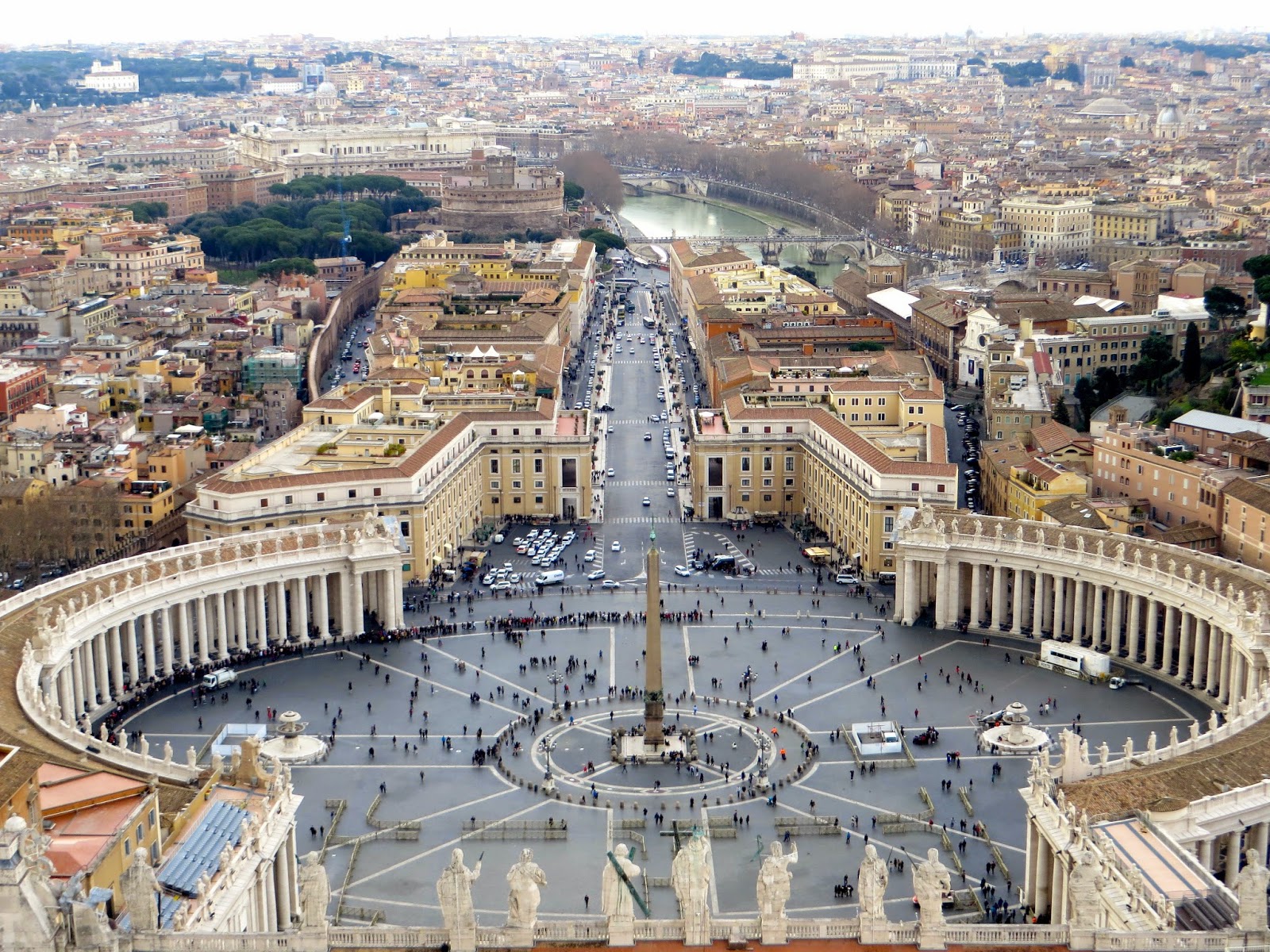
Finally, we arrived at a narrow platform circling the outside of the dome. The panoramic views from the top were amazing! We could walk all the way around the dome, and each side offered a beautiful perspective of the Vatican and beyond. At this height, I was able to fully appreciate the gorgeous bright colors of the buildings.


One side offered a good perspective of the lush and pristine Vatican gardens.


I really like how some of these Italian apartments are laid out in a pentagonal shape, with a large private courtyard in the center of the block.


Far off into the distance, some mountains shrouded in mist and clouds...


...and closer up I could see the people waiting in line to gain entrance to St. Peter's Basilica.


On another side are the Vatican Museums, which I visited later on the trip.


It’s a bit crowded up on the outside of the dome, and hard to move around other tourists in the narrow space, but well-worth the unique experience and the terrific views. By the time we got down from the dome, it was already the early afternoon. It's not impossible to do the Basilica and the museums in one day, but I think it is better for one's stamina and appreciation of the beauty and history to split it into two separate days. 

Sadly, it's very easy for one to get adjusted to beauty, even at this magnificent level...


Il Colosseo


The Colosseum is possibly the most historic icon in Rome. Obviously an extremely touristy destination, it remains a must-see for any visitor. It's the largest amphitheater in the world, and historians estimate that it could seat up to 80,000 spectators in its heyday. 

An admission ticket to the Colosseum includes admission to the adjacent Palatine Hill and Roman Forum, the vast expanse of ruins which once was the center of public life during the Roman Empire. The normal ticket is 12 euros, though there is free admission on the first Sunday of every month. 

We luckily happened to be in Rome for the first Sunday of March, so we planned our visit on this free admission day. We entered from a side gate in order to explore Palatine Hill first.  


The whole area is what one would consider an open-air museum. Palatine Hill overlooks the Roman Forum, and this hill is where Rome originated. The ruins of the ancient residences of affluent citizens are located here.


Palatine Hill overlooks the densely layered Roman Forum. This was the center of market activity and civic life in ancient Rome. There isn't too much in the way of signage or information plaques, so I felt like I did not get a full understanding of the meaning of this site, besides the names and dates of some ruins. If you aren't too familiar with the history, it may be beneficial to take a guided tour or an audio guide.


However, it would have taken a lot of time to examine and admire each of the individual ruins, potentially an entire day, and we had to rush to the Colosseum before it closed at 5PM. Because it was a free day, there were long lines from both sides of the entrance. The line moved quickly because people did not have to buy tickets, but we were worried because it was nearing 4PM, when the guards would stop allowing people entrance.


We were in luck again, and were one of the last few people admitted before the line was cut off to the disappointment of the long line of tourists behind.

On the upper levels, behind the main amphitheater, is a small museum with displays, artifacts, and information. I breezed through that part to arrive at the inside. It surprisingly seemed a little small to me, but then I had to remind myself that it was built in the year 80 AD, long before the engineering and architectural innovations that allow us to build high-rise buildings and giant sports stadiums.


The Colosseum was used as a stage for public entertainment for the citizens of Rome. These spectacles were often violent and took the forms of animal hunts and gladiator fights, as well as executions of prisoners. The stage is removed so we could peer beneath, seeing the tunnels and contraptions that used to store wild animals (rhinos, hippos, lions, etc) and gladiators before their public appearance.


Soon enough, at around 4:45PM, an announcement proclaimed that the site was closing down for the night and asked us to proceed to the doors. We did a final look around, and I tried to imagine the bloody, savage fights and rowdy crowds that used to fill the stadium two millennia ago, but it was almost impossible. In its closing hour, with the vestiges of sunlight and the fading last voices of tourists, the Colosseum seemed quite peaceful.