Showing posts with label Changsha. Show all posts

Thursday, January 2, 2014

Some Constants

Some aspects of China have not changed much since my last trip. Streets in older neighborhoods still have the same gritty atmosphere and characters; toddling babies, elderly men spitting upon the asphalt, motorbikes swerving around pedestrians, delicious smells of fried food and steamed buns wafting from food stalls...


My aunt and uncle work at a university in Changsha and live in housing on campus. Their apartment is right next to one of the canteens, and one chilly morning we headed down to eat some hearty and simple food. The canteen is exactly as it was before, no frills, just cheap and good food. Why change what works, right?

They sell some of my favorite breakfast foods, including all manner of steamed breads, including mantou (steamed bread), baozi (steamed bun stuffed with meat or a sweet filling), and zhuanzhi (steamed dough twisted into a roll and seasoned with sugar or onions). I've tried making these before, but for some reason the homemade ones are never as soft and fluffy. 


Right across the way is the faculty canteen, where the food is supposedly a bit better than the student side. They were serving noodles that morning as well as dim sum.


There is no heat in the eating area, so everyone bundles up in their winter coats and drinks steaming soy milk to warm up. Though Starbucks and other cafes have opened up plenty of outlets, the coffee culture hasn't quite permeated the Chinese market to the same extent as it has in the U.S. People do enjoy drinking it from time to time, but coffee has not yet become a daily ritual for the average person. Hence why you most likely won't find it sold in canteens. Coffee drinks are relatively pricey, and probably are consumed mostly by young people out with friends or by young professionals. 


There are many large, new malls in Changsha that sell both upscale Chinese and western labels. However, we decided to go to Gao Qiao, an older wholesale district that offers many traditional foods and knickknacks. The area is packed with small stores, and we walked through an area with lots of dried goods such as dates, nuts, and goji berries. There is a lot of selection, so buyers go along and try bits of the product before haggling the price with the vendor. 


I think this is some kind of squid?


Below is a photo of dried wood ear mushrooms, the same as what I ate in Hong Kong.


And of course one thing that hasn't changed yet is the pleasure of eating a large meal surrounded with family. We went to visit relatives who own their own small restaurant, and they were kind enough to cook our whole family a big meal full of fresh ingredients. In the photo below are my two grandmothers!


Large meals out with family are always great raucous fun, with people pushing each other to eat more and drink more, followed by the inevitable fight for the bill at the end. I'm glad these social customs still remain.

Tomorrow I'm leaving for my last trip of the winter break, to Hanoi in Vietnam. I hope that it's not as cold there as it is in China, and when I'm back in six days I'll be sure to post photos and updates! 

A Changing Landscape

It seems trite to say that China is changing, as it has been for the past few decades - and while the direction of the changes has remained similar to the past (towards urbanization, modernization), the scale of the change grows exponentially.

Last time I was here in 2010, in order to get from Changsha to Shenzhen I had to take an overnight train ride in a "hard sleeper," with 6 beds squeezed together in one train compartment. I slept on the top bunk in such a tight space that I couldn't sit up during the ride but had to remain lying down. Now the high-speed train system has opened, and the same inter-city journey only takes three hours.


The train runs so smoothly, despite reaching speeds of over 300 kilometers per hour! It was really interesting to look outside the window, though the ride was definitely comfortable enough to nap. We rode through mostly rural countryside, around hills and mountains, into deep tunnels. Despite these regions being far from the dense cities, no piece of land remained untouched. There is agriculture or construction everywhere, vast pieces of earth being cultivated or developed. 


We later visited a park in Changsha where we could observe the high speed trains whizzing by. They go by in a flash, it was so difficult to get a good photo! You hear a faint low rumbling and then whoosh! the sleek white train passes. 


Downtown Changsha is also being unearthed. The government has been developing a subway system for awhile (I remember construction happening from my last trip), and it's a massive operation, disrupting the flow of downtown vehicle and pedestrian traffic. I can't imagine how much work it must be to create underground tunnels in such an old and established city. Hopefully the subway system will help to alleviate the intense traffic jams that choke the city everyday. 


The city has also expanded on the outskirts with the housing boom. Large suburbs and units of apartments and condos have sprouted up, catering to the well-to-do who want to live outside of the hectic city. The housing estates are private, gated communities, sometimes themed in a particular architectural style. The community where my uncle lives has a Spanish theme - the houses are designed similarly and the street signs have Spanish words next to the Chinese. There are also perfectly manicured little paths and parks threaded throughout the suburb, dotted with plots of palm trees and elaborate fountains.  


This particular suburb was mixed with stand alone homes and condos in high rises. There were many empty units, as many residents have invested in real estate without renovating and moving in. You can tell when a house is lived in by whether there is a trash bin on the curb, and a condo unit by whether there are clothes hanging outside the windows to dry. The streets almost reminded me of a movie set, with fancy well-maintained houses but a vague unsettling absence of people.

Even though most well-to-do families own washing machines, most still prefer to air-dry clothes rather than buy a dryer. It's the original solar power! Even though temperatures were chilly, in the low 40s and upper 30s, there was a good amount of sunlight in the afternoon.


Monday, July 19, 2010

Goodbye, Changsha

So I'm actually back in Shenzhen for a few days before heading to the World Expo in Shanghai. I left Changsha by train on Sunday night. On my camera there still are many random pictures of my Changsha days.


Does this above dish look familiar? It is hotpot, and I had it once in Beijing here. Only this time, I remembered to take pictures of the many different foods that we cooked in the soup.

For example, we had fish balls, noodles, cabbage, hot dogs...


...bok choy, more fish balls, more cabbage, imitation crab...


...and second helpings of all of the above. Blame my cousin, who ordered 2 portions of every single dish. Still, it was really cheap! Including drinks, the whole meal added up to about 50 Yuan, which is about $8. Insane!


Here is a hole-in-the-wall place that my cousin and her friends like to frequent in downtown Changsha. It specializes in hot and sour noodles.


On another day, my oldest cousin treated us to lunch at a Japanese sushi place. It was a really fun restaurant where the sushi is plated and placed upon a conveyor belt. When we saw something we liked we would remove it from the belt. Each plate was colored differently to indicate a different price. After we were finished eating the waitress calculated the price by looking at the number and type of empty plates we had.


This next photo was actually not taken in Changsha but Xiangyin, the little town where my paternal grandparents live. It's a billboard proudly showing off the three students in the town who got accepted into the top two Chinese universities. One is Qinghua University and the other is Beijing University. Underneath their photo are their examination scores. I think this really shows not only the importance of education but also the closeness of the citizens of this small town.


I just thought this next sign was strange but witty. "Save Maoney Everyday." It's in a large Wal-mart in Changsha.


Well, I'm off to see the Expo! Wish me luck that I won't have to wait in lines for eight hours each day!

Saturday, July 3, 2010

Education, Part II

So the other day I had another look at the pressure-cooker environment of students in China. My cousin has just completed middle school. While she was at school, she basically had to do homework all night. I remember my middle school years - I would rush home and quickly speed through about half an hour's worth of homework so I wouldn't miss my favorite TV shows.


I took a peek at some of her past homework. She was learning complex algebra and calculus that we don't learn until upper level high school math class in the states. Crazy!

In China, middle school students take national exams at the end of their middle school career. What scores they receive determine which high school they will be able attend. Which high school they attend will greatly affect what college they may be able to get into. Therefore, the pressure is on to get into a top high school in the district. This is why most high schools are boarding schools - because the students' homes may be all the way across the city.

I have heard that middle school and high school are extremely tough years but college is really easy. The students spend so much time and effort throughout their whole lives to get into a top college, that when they finally get there, they let loose.


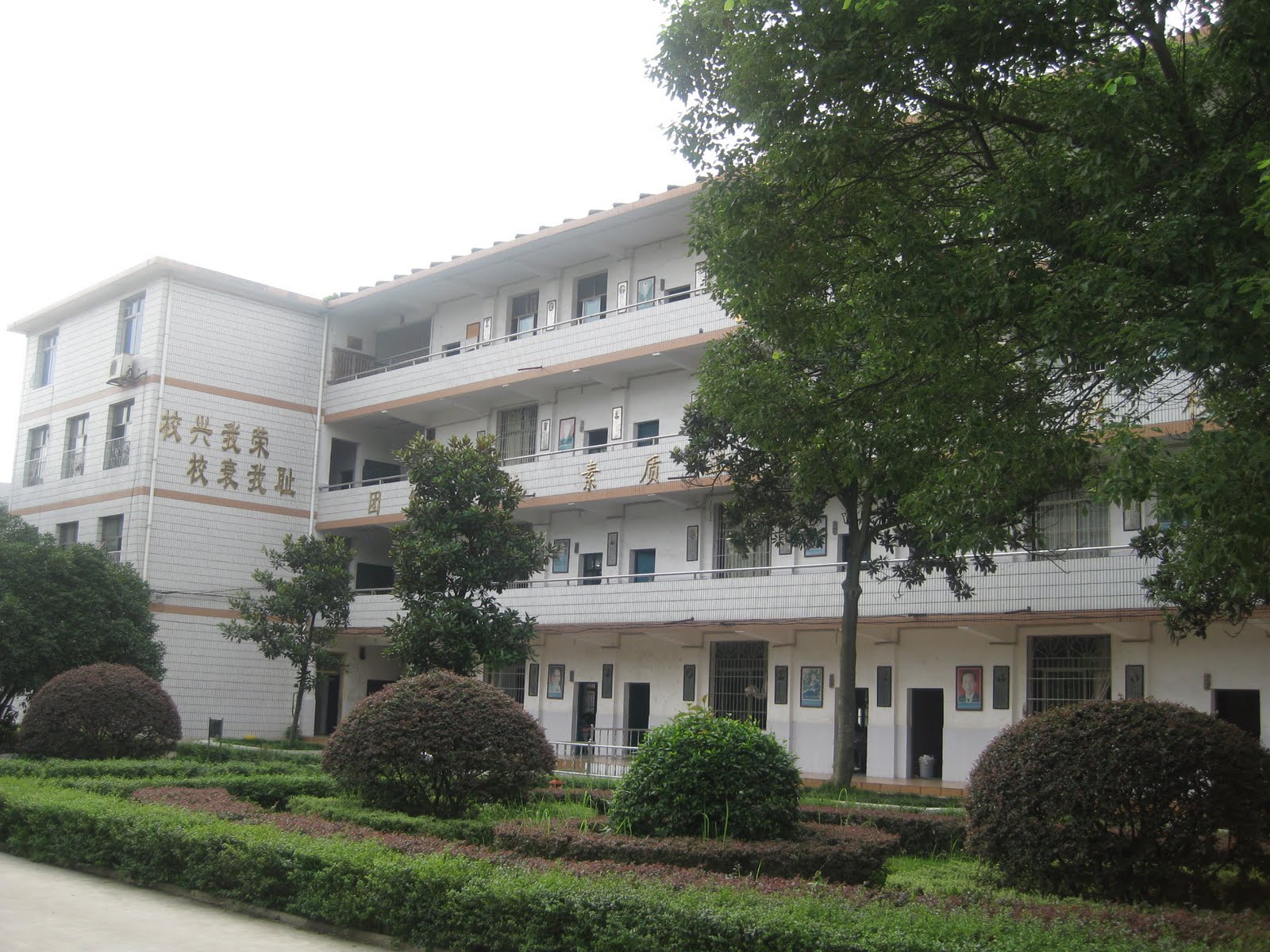
This is my cousin's middle school. Each classroom holds about 60 students. Most schools are in the same "open" design, with no indoor hallways or passageways. There is no air conditioning so in the summer heat so attending class can almost be unbearable. I have heard stories of students fainting during class.


There is no such thing as discretion and respect for privacy in the Chinese education system. Where one sits in the classroom is determined by one's grades. My cousin told me that the best students sit in the second row, the next best in the third row, etc. The worst students sit in the front row. Grades are posted publicly for all to see.

This chart, I believe, publicly records the behavior of all the students.


The school environment is really strict as well. All students wear uniforms. Romantic relationships are frowned upon because they are looked upon as a distraction from academics. Students have to go behind not only their parents' but also their teachers' backs to date. I think it's really strange that personal relationships are included in the sphere of a teacher's authority.


Grades came out today and I am happy to say my cousin got top scores so she can have her pick of any high school in the city. I'm hoping she can finally relax, but nope - her parents enrolled her in an English class that meets for nearly 3 hours every night.

Here is the link for Education, Part I.

Monday, June 21, 2010

Weekend in Changsha

My cousin, in her late twenties, invited me to crash over at her place in downtown Changsha for a weekend. It was the perfect timing as I had just returned from my trip from Zhangjiajie National Park and had a couple of days before leaving for Xi’an.

Currently she lives in the bustling city of Changsha with two other roommates in an apartment next to her workplace. She lives pretty much in the heart of the city, within easy reach of shops, restaurants, and public transportation. Her fiancé was also there during my visit. It was an interesting and fun experience hanging out with these young urban professionals.

On Friday night we went with her friends to a wonderful performance at a huge theater. It was a typical Chinese theatrical show that included acrobatics, audio/visual effects, singing, dancing, and a comedy routine. I took a few pictures before I was informed that cameras are not allowed. Oops!


We spent most of the day shopping on Saturday. I cannot believe how cheap the taxis here are. We rode for about fifteen minutes and paid the U.S. equivalent of $1.60. There was not even a starting fee.

For lunch we went to a restaurant with a very interesting specialty – bullfrog. Every single table had this steaming hot pot of spicy bullfrog. It actually tasted like chewy fish – not too bad! Only afterwards my lips were numb from the spiciness of the dish.


Dinner was much milder. We ordered simple foods such as mantou, soy milk, pumpkin soup. They were still really cheap – only about $1 per dish. I had to laugh at the translation of the pumpkin soup on the menu – they called it pumpkin “gruel.” Someone needs to teach the translator how to make the names of dishes sound more appetizing!


My cousin is always busy with work – right now she is doing some overtime on this Saturday night. Her job deals with carbon emissions, so it’s very comforting to know that there are people trying very hard to solve our environmental problems.