Showing posts with label Korea. Show all posts

Sunday, December 21, 2014

Bukchon Hanok Village


The Bukchon area is a must-see if you are in Seoul. This is a traditional Hanok residential neighborhood, very much still lived-in, with lovely architecture, winding alleyways, surrounded by boutique shops and cafes. It's near the Anguk MRT station, and within walking distance of the major palaces.

The streets surrounding the neighborhood, down below, are full of interesting shops. You can see that at several points, stairways lead upwards from the main street towards the residential area.


There was an interesting looking vintage second-hand shop, with clothing displays leading up to the store. I wish I had time to take a look; secondhand stores always hold such treasures if you are willing to do a little bit of digging. 


Each alleyway offered its own surprises; family-owned restaurants, cool cafes, hand-made gifts stores. 


Finally we climbed upwards towards the residential area, which has a 600-year-old history. There was a nice view from the top, where we could see the nearby neighborhoods and rooftops sprawled out before us, with mountains in the distance.


The Bukchon Village alleys had many signs that cautioned visitors to be respectful and quiet, as families still do live in the homes. Some of the houses, though, had been converted into cultural centers, handicraft workshops, tea houses, and guesthouses.


There is somewhat of a walking path through the neighborhood, and various tourist maps and signs will point out where you are. Depending on how fast you walk, and whether or not you stop, I'd say you could go through the entire route in thirty minutes to one hour.


Even on this cold and snowy day, there were plenty of people walking up and down the main alleys. This little girl was fascinated by the snow.


Overall, it was such a lovely walk, and a great way to spend an afternoon seeing a different perspective of Seoul, usually pictured as a throbbing metropolis.


Gwangjang Night Market


Gwangjang Market in Seoul offers a variety of traditional Korean street foods at night. Even on a cold evening, the covered arcade was bustling with both locals and tourists. There seems to be a few staple street foods on offer at Gwangjang.

One kind, which we did not try, is a type of big thick fried pancake, made with a flour or egg batter. It is filled with a variety of different foods like vegetables, meat, and seafood.


At Gwangjang, each shop has stools right on the street so people can sit, eat, and watch their food being cooked. There isn't as much grab-and-go as you'll find at a Taiwanese night market.


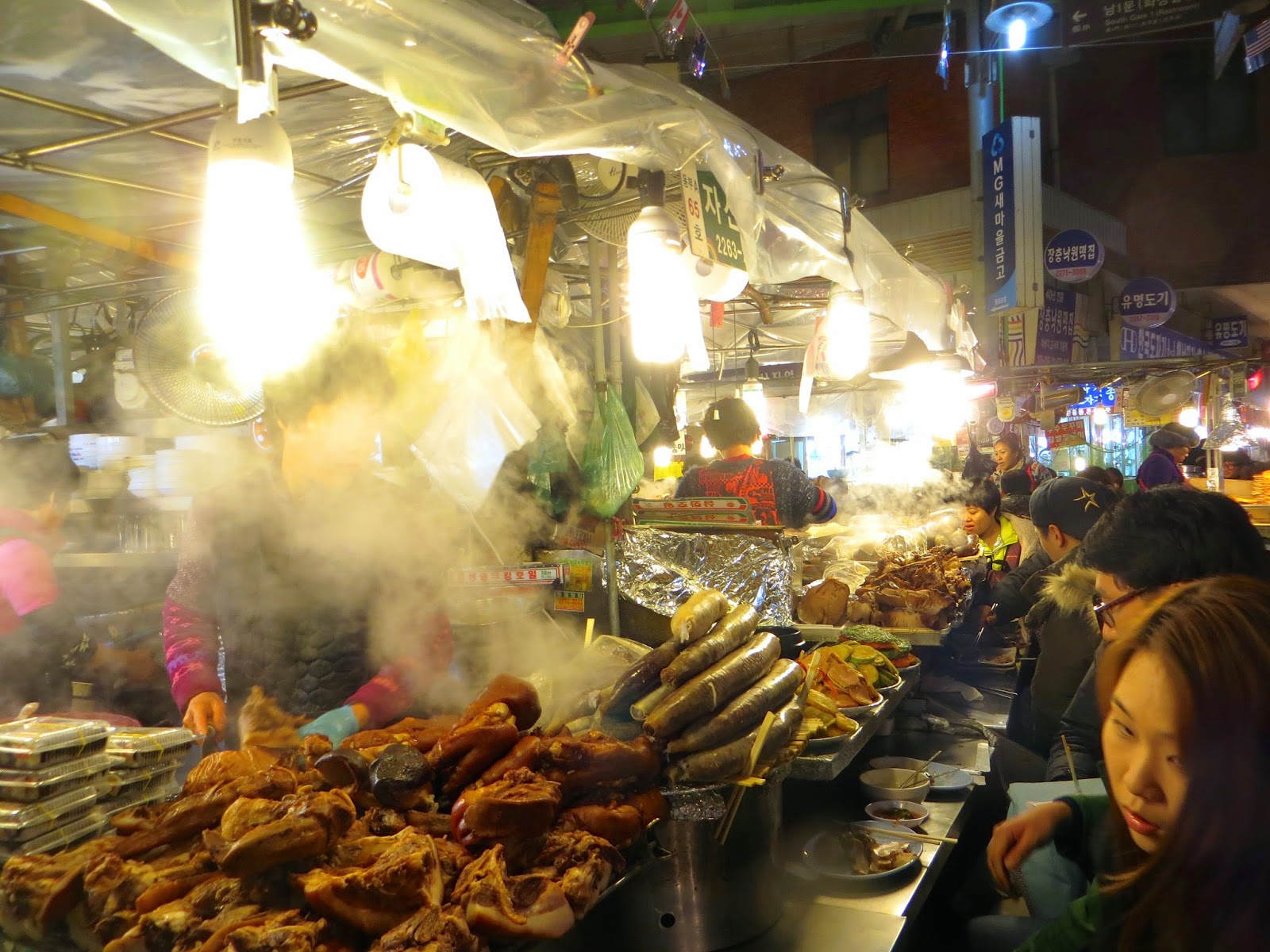
At an intersection within the market, the crowds were dense, and there were so many vendors placed together, creating a thick cloud of steam with their cooking. The whole place smelled delicious and was warmed up by the steam.


Some of the most popular vendors had all their seats filled, but so many places sell the same foods so you will have no trouble finding something to eat.


We found a slightly quieter and emptier part of the market, where a long line of vendors were all selling noodles and steamed Korean dumplings called mandu. We decided to go for some dumplings, which looked plump and fresh. The seats were heated, a nice touch on this wintry night.


There were two types of dumplings, meat and kimchi. One order of each was $5 USD, and the owner recommended that we split a plate of half of each kind of dumpling.


On the plate below, the rounded moon-like dumplings are pork, and the other kind is kimchi. They were really good! I especially liked the pork dumplings - thick and meaty.


We also decided to try a dish that sounds very strange but we saw lots of people eating - "sundae." It's a plate of various types of meats and offal, including pig stomach, liver, and intestines stuffed with glutinous rice. A big plate of this meat was $10 USD, and included some soup and side dishes.


It wasn't too bad! The meat had interesting textures. A whole plate of it would be too much for one person though, in my opinion.


There were also various traditional shops lining the arcade, though most of them appeared closed for the night. It was a fun night market experience, very different from the Taiwan night markets though. I would go back for the dumplings!

Thursday, December 2, 2010

New Situation on the Peninsula

So I guess I was wrong, at least partly, in my post about 2 months ago about North and South Korea. In that post, I wrote:

"I really don't see any military conflict happening in the near future, thank goodness. I also don't see reunification happening between the Koreas for at least a decade. The succession in North Korea will probably occur smoothly and I doubt the new leader will make any visible changes to foreign policy. Japan and China will get over this incident because they are big trading partners and sometimes economics trumps politics. So, in my opinion the region will remain in this standstill for now."

That's one of the cool things about keeping a blog, is that you can actually see how your perspectives and situations change. If you've read the news, you probably have heard about how North Korea fired shells onto South Korea's territory. It was an unprovoked attack on civilians and has definitely further raised tensions in the region. This action just shows how unpredictable North Korea is. Why are they being belligerent when they depend on their neighbors for so much food aid? Additionally, the North is in a fragile state right now, dealing with their leadership transition.

So does North Korea have some sort of method behind this madness? Or are the leaders just mad, likely in more ways than one? I'm not sure, but China should really try to get a hold of the situation. It seems to be the one remaining anchor that can keep North Korea stable.

Wednesday, September 22, 2010

Trouble in the East Asian Seas

There has been a lot of drama in East Asia in the past few months, shifting international attention from environmental and economic concerns to fears of deepening tensions between rivals and military confrontation.

First North Korea torpedoes a South Korean ship off its coast and kills forty-something sailors. This incident is one of the worst military provocations on the Korean peninsula since the Korean War. Obviously, this significantly sours the North-South relationship, and South Korea threatened to stop trade with its neighbor. China was put into a quandary. After all, it traditionally has been one of North Korea's only allies. However, with the U.S.'s and the U.N's strong support of South Korea, China could not easily defend the rogue nation. Therefore, it remained "on the fence," trying to ameliorate the situation with no success.

The situation took an almost childish turn in which South Korea stating that it would re-designate North Korea as its "archenemy." China, on the other hand, faced mounting pressure to make Kim Jung Il face responsibility for the events. Trying to be objective, the Prime Minister of China offered his condolences to South Korea while cautiously not directly accusing any actor for the sinking of the ship.

Meanwhile, North Korea fervently denied any involvement with the sinking and threatened military action if it received a U.N. condemnation. The North Korean ambassador to the U.S. stated, "our people and army will smash our aggressors." I don't underestimate North Korea's ability to take rash actions, but it's not like they have never faced U.N. pressures before.

The U.S. and South Korea began naval drills on the coast of the Korean peninsula. These drills involved over 8,000 personnel and 200 aircraft. Then the two sides go back and forth, with North Korea threatening retaliatory action. It seized a South Korean ship and fired rounds into a disputed sea border. It seemed like direct military confrontation was inevitable.

Then, in a sudden turn of events, North Korea freed the detained ship and South Korea suggested a reunification of families that were separated by the Korean War. It also agreed to send flood relief aid to the North. North Korea then proposed military talks to settle some border disagreements. It seems like tensions are cooling. However, as this one incident wraps up, another one begins.

China and Japan, two other rivals in the region, have begun a spat over the detention of a Chinese captain who had sailed into a disputed area between the two countries. The island in question is called Senkaku by the Japanese and Diaoyu by the Chinese. China is arguing that Japanese officials do not have jurisdiction to prosecute the man. Now China is refusing to talk to Japan during the U.N. meeting. I don't think there has been conflict on this level between the two countries since the controversy a few years ago over the publication of Japanese textbooks that did not fully explain Japan's part in the atrocities of World War II.

Wow, so there are still a lot of problems in the region. China and Korea have deep-rooted anger towards Japan for historical reasons. The two Koreas struggle to find a way to coexist. The U.S. backs South Korea and Japan militarily. China tries to balance its alliances but has to keep supporting North Korea. North Korea, meanwhile, is trying to sort out the succession of Kim Jong Il's son. The world waits with bated breath to see the conclusion of this power transition. Each country tries to become the regional hegemon. In a way, it kind of sounds like some kind of soap opera, doesn't it?

It's also really difficult because of the range of political and economic systems in the region. South Korea and Japan are both capitalist and democratic. North Korea is an enclosed communist nation in which a dictator rules with an iron fist. China economically, is teetering between its past socialist roots and its capitalist future, while remaining essentially a totalitarian state.

Any predictions as to what will happen? I really don't see any military conflict happening in the near future, thank goodness. I also don't see reunification happening between the Koreas for at least a decade. The succession in North Korea will probably occur smoothly and I doubt the new leader will make any visible changes to foreign policy. Japan and China will get over this incident because they are big trading partners and sometimes economics trumps politics. So, in my opinion the region will remain in this standstill for now.