Showing posts with label environment. Show all posts

Tuesday, November 16, 2010

A Lunch with the Chair of the IPCC, Dr. Pachauri

This past week I had the honor of attending a private lunch with Dr. Rajendra Pachauri, the current Chair of the Intergovernmental Panel on Climate Change. The IPCC is the largest international organization dedicated to gathering the scientific evidence on climate change from scientists around the world. It shared the Nobel Peace Prize with Al Gore in 2007.


Dr. Pachauri spoke to a group of about 12 students, so the talk was intimate enough that we were able to ask questions. One student asked him his opinion of the role of the developing world, especially China and India, in the climate change issue. Many developing countries think it is unfair for them to have to curb carbon emissions just as their economic growth begins and so many of their citizens still live in poverty. For example, though China's economy is growing at unbelievable rates, many Chinese still experience a very low standard of living. Is there a way to curb greenhouse gas emissions without hurting the economy as well?

Dr. Pachauri believes that developing countries would be making a mistake if they chose to go through the same trajectory as the developed countries did. They need to find their own way to develop in a sustainable and environmentally-friendly way, without compromising their economy or the well-being of the impoverished. They could possibly try to do this by utilizing new technology. He emphasizes that this is an opportunity for developing countries to divert from the "business as usual" approach and really be innovative.

One step would be to price goods in a fair, transparent manner, without providing subsidies to goods such as oil. For example, the price of our oil does not actually reflect all the expenditures that are spent on our oil supply. Moving in a "green" direction does not necessarily lead to economic loss. The prices of renewables will only decrease, whereas oil prices can only rise in the future. Dr. Pachauri points to Germany and South Korea as examples in which sustainable changes led to economic gain.

I think that Dr. Pachauri makes valid points, but it still will be very difficult for China and India to drastically decrease carbon emissions without compromising their growth, especially if the leaders focus more on short term growth. The environment is a global public good; China will directly gain more by using cheaper and dirtier fuels than it will lose. All countries will share the burden of climate change.

China has begun large-scale initiatives that move it towards sustainable growth, but there will probably have to be some economic incentives in order for it to lower emissions to a level that will acceptable to everyone in the international community.

Do you think developed countries owe the developing countries anything in exchange for lowering emissions?

The image above is from Undergrowth.

Sunday, November 7, 2010

Outsourcing Jobs = Outsourcing Pollution

I was talking with a visitor from China this past week about the beautiful weather we have been enjoying lately. She told me she sent a few pictures of Yale back to friends in China. The children that viewed the photos were amazed, not because of the centuries-old Gothic architecture, but because they had never seen a sky so blue.


Now, I was taken aback, because believe it or not, Yale is located in an urban area, and New Haven is considered a city. There are cars, buildings, construction, and streets. When I arrived last year, I remember complaining to my parents that the poor air quality of the city would cause me to develop some sort of respiratory disease. After all, for all of my life I have lived in nice suburban areas full of trees, blue skies, and sunshine.

Obviously, I had never experienced real pollution. This summer, I had a little taste of the air quality problem in China. The skies were always muggy, smoggy, and gray. First I thought it was just heavy cloud cover, until I realized there couldn't possibly be so many cloudy days during the summer months. It was true - if I peeked hard enough I could detect the hard bright glimmer of sunshine blocked by the layers and layers of pollution covering the sky.


The city pictured here isn't even that bad, believe it or not. This is Shenzhen and twenty-something years ago it was just a tiny fishing village. It has only suffered two decades worth of damage.

So my point is, we only see the bad side of companies moving their factories and jobs to countries like China. Yes, our manufacturing sector may be suffering and people may have to seek employment elsewhere, but the corporations are also taking their pollution and carbon emissions with them. By uprooting their factories, we do not have to deal with the immediate effects of smog and particulate matter.

My friend sees it this way: China is the factory of the United States. Chinese citizens may receive manufacturing jobs, but they also are paying indirectly because of the negative externalities. Respiratory diseases have become very common in cities. Buildings only a few years old look run-down and dirty from all the dirty residue from the air. It's another way to look at the debate over moving jobs and factories overseas. As the U.S. moves from being a manufacturing nation to one that provides services and technology, its environment and its citizens are benefiting.

Tuesday, September 14, 2010

The Controversy Over Cheap Clean Energy


The short story is that the Chinese government has been subsidizing the development and production of these technologies for its domestic companies. Then these companies have been able to sell its products at a lower cost and still make a profit. Apparently, the Chinese companies have begun to sell the products such as wind turbines and solar panels at below cost to U.S. companies. The argument is that this action is hurting certain U.S. industries.

So I can understand how certain sectors of the U.S. economy would lose out due to the low prices of the Chinese companies, such as the manufacturing industry. However, it is hard to wrap my brain around the fact that people would rather have the Chinese selling at higher prices. It's not as if clean energy is bad for anyone. In fact, it seems like other sectors of the U.S. economy would be greatly benefited from a cheap source of clean energy. Becoming less dependent on fossil fuels and foreign suppliers of oil seems like a win-win situation because it helps ease pollution and lower dependency on oil.

The Chinese government is doing a good deed by granting these subsidies. Maybe the U.S. government should also subsidize its own companies so they won't be undercut by competition? Maybe it should move some of the tax dollars from inefficient agricultural subsidies? Really, there is no price too low for clean energy supplies. In the long run, the U.S. economy overall will benefit because other companies and consumers will have access to cheap clean energy.

The problem with switching to clean energy is the initial start-up cost of getting the equipment - afterwards, besides maintenance costs, there is basically a free flow of energy. From this angle, it definitely seems like Chinese manufacturers are helping U.S. companies get a hold of cheap supplies that will drastically lower their costs in the future, even if the Chinese companies only have economic motivations. I mean, hypothetically, what if the Chinese government just started giving us free wind turbines and solar panels? Would we still have the same reaction?

I don't know. I am definitely far from an expert in this field and there may be many issues that I am forgetting or don't understand. This is just my gut reaction to all the uproar over the incident. What do you think? Do I have a valid point or am I misunderstanding some fundamental principle?

Thursday, August 5, 2010

What I Will Not Miss About China

So last time I wrote about the aspects of China that I will miss. But everything has pros and cons, right? While living in China, there were definitely some things that really bothered me.

Crowds

It's no secret that there are over 1.3 billion people living in China. This creates congestion everywhere - in stores, in the streets, in schools. Buses and subways are always packed to the maximum amount of individuals possible without someone being crushed to death. At the Sam's Club in Shenzhen, on busy days sometimes there aren't enough shopping carts for all the customers. Traffic jams are a frequent and unavoidable consequence for city
dwellers and country residents alike.


Because there are so many people, each individual has to look out for himself. It is a dog-eat-dog world out there. People generally are impatient and will cut in line or push you out of the way. Most people are quite suspicious and therefore not friendly or welcoming to strangers. Both literally and metaphorically, if you let someone else get ahead, it only causes you to fall further and further behind. Of course, there are many exceptions to the rule, and once people get to know you they will treat you like family.

Environmental Degradation

I have written about China's environment before. It is hard to balance every individual's desire for a higher standard of living with the subsequent impact on the environment. My grandfather believes that right now China is just going through its development and afterwards the environment will improve. But the people and the government will never be satisfied with a set level of development. It is human nature to always want more once you have achieved your initial goal. Now your family may have a washer to do laundry, but wouldn't a dryer make life much easier as well?

In many cities that I visited, the air was heavy and the sky was smoggy and gray. There was a stunning lack of green grass and large trees. People tossed trash on the sidewalks without a second thought. Little kids relieved their bladders in the streets. Empty Styrofoam ramen noodle containers floated in rivers.


Additionally, people smoke everywhere - in cars, in restaurants, on buses and trains. Since regulations are so stringent in the U.S., it had been so long since I had actually inhaled cigarette smoke. At first I tried holding my breath every time I passed by a smoker, but I quickly realized this was probably the faster way to die, considering some of my own relatives smoked regularly.

Lack of Diversity

I have never fully appreciated how diverse the United States is, in terms of both race and culture as well as in perspectives and ideologies. Even in a relatively homogeneous place where I live (as compared to New York or Los Angeles), I can still find every single race represented, and people all along the political spectrum. It is easy for me to go to a public location and hear Chinese or Spanish spoken.

In China, outside of the more worldly cities such as Beijing, foreigners are a sight to be stared at. As soon as a foreigner walks into view, whispers commence about their hair color or their stature. It is very awkward, especially since most of the foreigners are fluent in Chinese. Some citizens are even brave enough to ask to have their picture taken with the said foreigner. Of course, though Chinese people may be one race, they can have very different appearances - short, tall, slender, pudgy, wide or narrow faced, large or small featured, etc.


Most Chinese citizens also have the same general opinions about politics and issues such as Taiwan and the U.S. This is the result of state-controlled media and education system. This reason is probably why most people do not talk of politics in everyday conversation. After all, what is the point in discussing if you already agree? I think this might start changing with the younger generation, especially with the rise in Internet usage. Though there are censors on certain websites, the government cannot possibly shield its citizens from all controversial information. We will see what will happen in the future.

Friday, June 18, 2010

Development

I know I mentioned before that China is really in a stage of rapid growth, but I did not realize the extent of this development.

There is literally construction and building everywhere. No matter where I turn, whether it is in a small town, a mountain, a highway, or a city, there is development. Malls are constructed, new apartment buildings are erected, roads are widened, mountain tunnels are blasted, and fields are overturned. It is crazy.


Not only does this mean an insane amount of traffic jams in an already crowded place, but it also means constant noise, dust, and pollution.

In the late 1950s, Mao Zedong wanted China to develop extremely quickly and catch up with the Soviet Union and the United States. This “Great Leap Forward,” in which China would “leap” over the normal stages of economic development, caused tens of millions of people to perish of starvation. Individual farmers were grouped together into communes to collectively plant and harvest crops. People melted all their household iron products such as pots to create material for industrial use. Figures for crop harvest were exaggerated by local Communist leaders in this frenzy for growth.

My grandmother described how she was extremely close to starving to death in one of the communes. People were given rations of food. Each person only received a handful of rice for a meal. My grandmother also had a young son, my oldest uncle, who she gave some of her portion.

Of course, this modern development is much better organized and planned out. It has helped a lot of people reach a never-before known standard of living. The new rising middle class has cars, TVs, appliances, and shopping and tourist destinations. More people have electricity, hot water, and jobs. However, that doesn’t mean the development doesn’t cause harm to many people.

A few days ago, on the highway I passed by this beautiful landscape. It was in the late afternoon, and the sun was just setting. Gorgeous terraced rice fields stretched out beneath the shadows of tall lush mountains. However, just beyond the border of the farmland was a huge smoke stack. It was pouring an immense black cloud that floated forebodingly above the peaceful countryside.

More people are also migrating from the rural areas into the growing cities. They usually receive jobs in construction or industrial labor. The city usually builds them some makeshift shelter to live in. Here is one such place right by my grandparents’ apartment. It is located underground.


Yes, they may earn a higher salary here in the urban areas, but the harsh labor coupled with lack of family and hours of overtime have driven some to desperate measures. Have you seen the recent news about the suicides at Foxcomm in Shenzhen, a corporation that supplies equipment to companies such as Apple?

I don’t know about you, but I think such a fast pace of change damages a country’s environment and the health, both mental and physical, of its people.

Wednesday, June 9, 2010

Environment

Though China produces so much pollution each year, each individual citizen actually only consumes a very small amount of energy. People have always been very conservative with their energy usage. There simply would be no way for every person here to have the same lifestyle as the average American. Below are some examples I have observed of energy conservation:

Plastic bags are not free at most grocery stores. They usually cost a Yuan each. Therefore many people bring reusable bags.

People usually line-dry their clothes. Nobody owns dryers. Some people do not own washers either and hand-wash everything. It is rare to see an apartment without clothes hanging out of the window or balcony. Usually if there are no clothes It means the apartment is unoccupied at the moment.


In my uncle’s home, hot water has to be turned on by a switch in the bathroom. At my grandparents’, the hot water heater is powered by solar panels from the roof.
There is usually no central air conditioning system. Many people use electric fans. My uncle is lucky to have individual ac units in each room. This system still saves energy because it does not waste power heating or cooling unnecessary areas of the home.

Public transportation is accessible and affordable. There are various types of buses, subway systems, and trains. Other people ride bikes or walk. Sometimes in cities it simply isn’t practical to own a car. In spite of this, air pollution is prevalent in most cities simply because of large population.


Recycling is becoming more popular now. However, most people seem to have no qualms about tossing a plastic bottle into the trash. Likewise, I have seen people just throw trash onto ground in public areas and spit onto the sidewalk without a second glance.


This leads me to believe that the environmentally-friendly ways of most Chinese citizens is not caused mainly by a concern for nature, but out of necessity and habit. There is not enough energy to go around for everyone to have washers and dryers. There is not enough space on the roads for everyone to own a car. There have been enough hard times in the past for my grandparents to still not want to waste a drop of water or a bit of food.

Still, as more and more people discover and demand a higher, western-style standard of living (personal cars, washing machines), China will experience a huge environmental strain and energy crisis. Therefore it is imperative that the country’s leaders figure out a solution that recognizes both citizens’ legitimate wishes and the environmental ramifications of a new age of economic prosperity.


Monday, May 31, 2010

Gated Neighborhoods

People here live in tall apartments which are in gated neighborhoods. Each neighborhood has its own shops, markets, schools, daycares, etc. We have a swimming pool downstairs along with lots of tropical vegetation and gorgeous landscaping.


I went to visit my little cousin’s daycare.


The kids eat breakfast in the morning there. Today they had noodles and little hardboiled eggs. I think they might be quail eggs? They are taught to finish their food before they play. Apparently the daycare workers are very attentive and actually will sit with the kids and feed them and encourage them to eat.


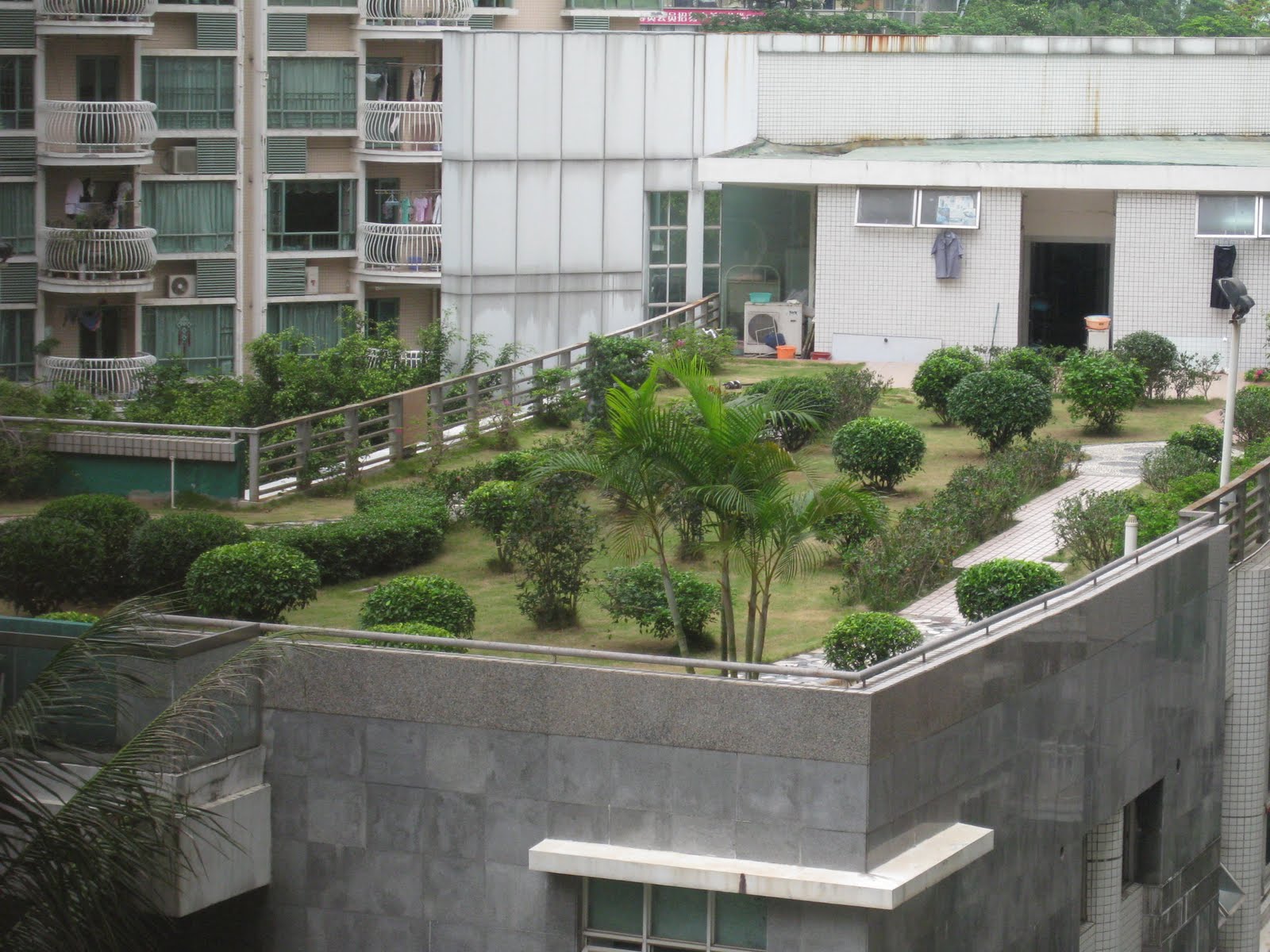
This next building is housing for workers and household help of the neighborhood such as security guards and housekeepers. It seems like everything is enclosed within this gated community like a mini-world. On the lower floor of the building is an exercise room.


Notice the rooftop garden! I wonder if this is for attractiveness or for environmental sustainability.


Here’s a squad of security guards doing exercises. Shenzhen seems like relatively safe city, so I’m not sure why there is a need for so much security.

My uncle lives on the fifth floor. He is definitely better-off than the average Chinese citizen. His apartment is relevantly large and nice, with three bedrooms, a kitchen, two bathrooms, and a living room. However, there are also eight individuals living here currently – my aunt, her mother, her brother, my uncle, my two baby cousins, my grandmother, and me. Additionally, there is a cook and a person that washes clothes. It makes for very cozy living! Unless you are extremely wealthy, square footage is scarce.


Here’s a sign of the spreading western culture.

Sumi, I hope you’re reading this. I found a “tree!”

See you soon!