Showing posts with label Rome. Show all posts

Monday, May 4, 2015

The Pantheon


Another one of the main attractions in Rome is the Pantheon, a beautiful temple built about 2000 years ago by the Emperor Hadrian, dedicated to all the pagan gods. The Pantheon is located in the middle of the city, off of the main shopping street called Via Corso, and admission is free.

We wandered through the gorgeous alleyways of the neighborhood known as Old Rome, and stopped to get gelato before arriving at the Pantheon at dusk. There was still a good crowd of visitors at this time of day, as well as some street performers and vendors, creating a lively atmosphere in the square in front of the Pantheon.


The architecture of the temple is astounding - the dome is enormous and perfectly round, with a circular opening at the top for rainwater to fall through. The opening also allows natural light to filter in during the day. It is the world's largest unenforced concrete dome!


It is still used as a church. I cannot imagine how amazing it would be a local and to go to church regularly in the Pantheon.


I wish I could have gone during rainy weather to watch the rain fall through the opening at the top of the dome (known as an oculus). The Romans were quite advanced engineers and built a drainage system underneath the Pantheon to capture the rainwater.


It had rained earlier that day so I could still see the last of the puddles of rain on the ground directly underneath the oculus.


Another interesting fact about the Pantheon is that it holds the remains of the famous artist Raphael, in a sarcophagus in one of the alcoves. Two kings of Italy are also buried in this space.


By the time we left the building, it was already nightfall. The square outside was as lively as ever, with a guitar player serenading the crowd. The Pantheon is a very interesting historically and architecturally, and additionally it is free, so I would highly recommend that any visitor to Rome drop by to take a look.


Friday, May 1, 2015

Il Colosseo


The Colosseum is possibly the most historic icon in Rome. Obviously an extremely touristy destination, it remains a must-see for any visitor. It's the largest amphitheater in the world, and historians estimate that it could seat up to 80,000 spectators in its heyday. 

An admission ticket to the Colosseum includes admission to the adjacent Palatine Hill and Roman Forum, the vast expanse of ruins which once was the center of public life during the Roman Empire. The normal ticket is 12 euros, though there is free admission on the first Sunday of every month. 

We luckily happened to be in Rome for the first Sunday of March, so we planned our visit on this free admission day. We entered from a side gate in order to explore Palatine Hill first.  


The whole area is what one would consider an open-air museum. Palatine Hill overlooks the Roman Forum, and this hill is where Rome originated. The ruins of the ancient residences of affluent citizens are located here.


Palatine Hill overlooks the densely layered Roman Forum. This was the center of market activity and civic life in ancient Rome. There isn't too much in the way of signage or information plaques, so I felt like I did not get a full understanding of the meaning of this site, besides the names and dates of some ruins. If you aren't too familiar with the history, it may be beneficial to take a guided tour or an audio guide.


However, it would have taken a lot of time to examine and admire each of the individual ruins, potentially an entire day, and we had to rush to the Colosseum before it closed at 5PM. Because it was a free day, there were long lines from both sides of the entrance. The line moved quickly because people did not have to buy tickets, but we were worried because it was nearing 4PM, when the guards would stop allowing people entrance.


We were in luck again, and were one of the last few people admitted before the line was cut off to the disappointment of the long line of tourists behind.

On the upper levels, behind the main amphitheater, is a small museum with displays, artifacts, and information. I breezed through that part to arrive at the inside. It surprisingly seemed a little small to me, but then I had to remind myself that it was built in the year 80 AD, long before the engineering and architectural innovations that allow us to build high-rise buildings and giant sports stadiums.


The Colosseum was used as a stage for public entertainment for the citizens of Rome. These spectacles were often violent and took the forms of animal hunts and gladiator fights, as well as executions of prisoners. The stage is removed so we could peer beneath, seeing the tunnels and contraptions that used to store wild animals (rhinos, hippos, lions, etc) and gladiators before their public appearance.


Soon enough, at around 4:45PM, an announcement proclaimed that the site was closing down for the night and asked us to proceed to the doors. We did a final look around, and I tried to imagine the bloody, savage fights and rowdy crowds that used to fill the stadium two millennia ago, but it was almost impossible. In its closing hour, with the vestiges of sunlight and the fading last voices of tourists, the Colosseum seemed quite peaceful.  


Saturday, April 25, 2015

Pizza and Gelato, Please!

As you can tell from the title, this post is going to be all about the wonderful and delicious food of Italy, and it will be long, because I spent a lot of time researching and trying out the best cheap eats in this culinary capital. Since I consider myself a budget traveller, I always scout out the best places at the lowest prices. Rome has a lot of great, inexpensive eats! Though we didn't engage in any traditional Italian fine dining, with multiple courses and exquisite wine, I would say we definitely were able to eat our way through Rome!


I'll start with pizza, which are the ultimate affordable and filling quick bite in Italy. Pizza is to Italy what Souvlaki is to Greece, in my opinion.

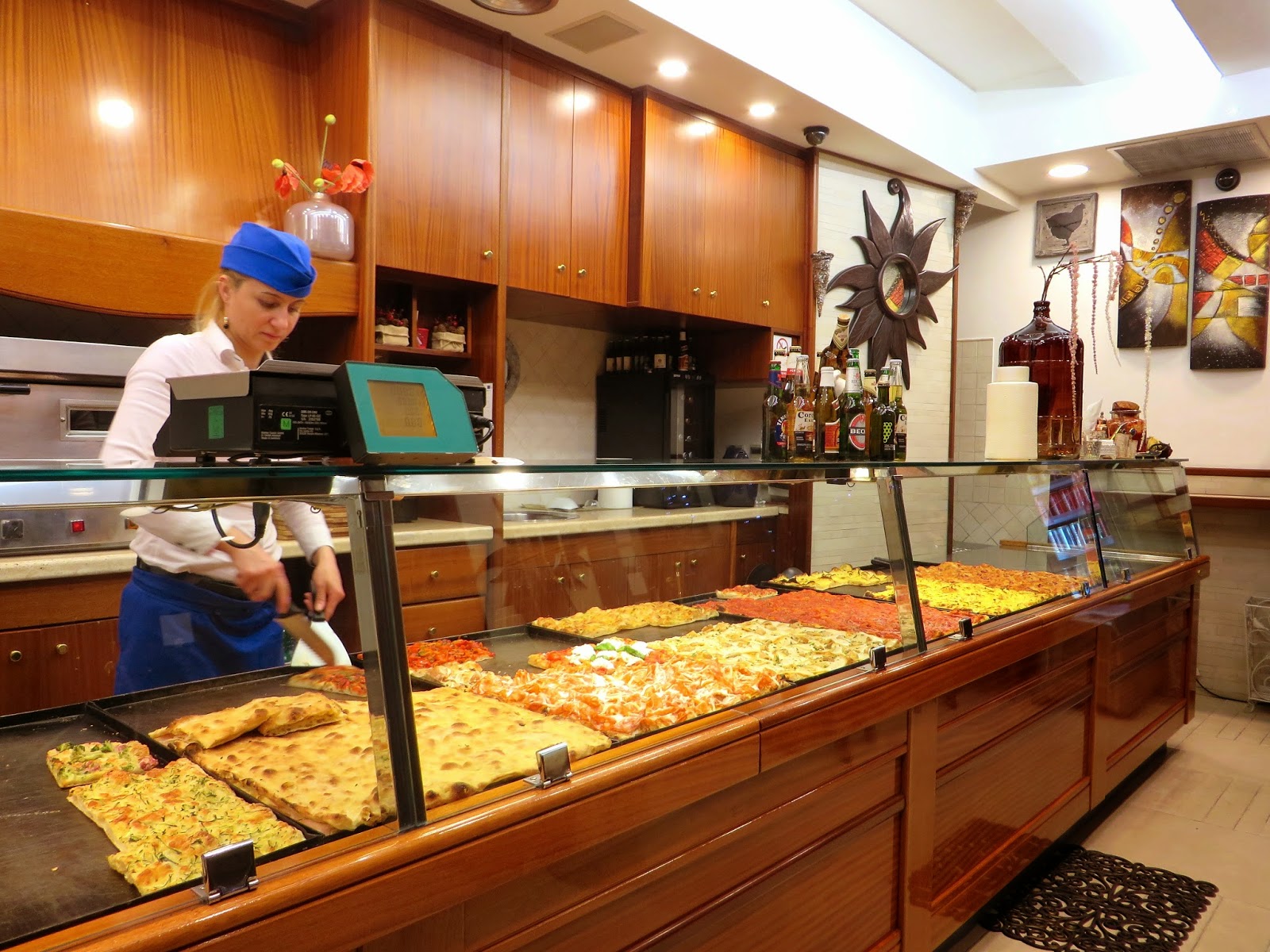
Most neighborhoods will have small nondescript pizza shops, which still offer pizza that is quite superior to your average American pizza. The pizza is all laid out in a counter, in rectangular shapes, and you buy the pizza by the gram. There are a lot of different types of pizza, some without cheese, and with lots of vegetable options like potatoes, onions, and broccoli.


After you tell the person working behind the counter how much you want, they heat the slice up for you so that your pizza is warm and toasty. You can get a decently healthy meal (like this pizza below with tomatoes and bell peppers) for about $5 USD. 


When we were in a hurry we would usually go to the nearest small pizza place, but of course I also wanted to try the best that Rome has to offer. I found that generally the difference between the top pizza shops and the average shops is that the ingredients are more fresh and higher quality, the crust is crispy and light, and the people are friendly and more adept at helping tourists.

We went to several shops that were rated highly on Tripadvisor. One of the first that we tried is called Zizi's Pizza. It is a decent family-owned joint, with a great variety of pizzas. We tried one with fresh mozzarella and prosciutto, and one with broccoli and spinach. I noticed that in Italy, cheese is merely one type of topping on pizza, unlike in the United States, where pizza is nearly always smothered in melted cheese.


The best pizza, hands down, is at Pinsere, a few blocks from the main train station. When I was there, it was rated #2 on Tripadvisor out of about 9,000 restaurants in Rome, which is incredible! If you are in Rome, you've gotta gotta gotta go here! It fully lives up to it's hype.

The place is tiny, and there is only a bit of counter space inside and outside where you can stand and eat. Don't let that deter you - the pizza here is out of this world delicious. The pizza comes in all sorts of creative varieties, in personal pan sizes. The pizza on the counter is partially cooked, and then after you order it is heated in a big oven. On the side, through glass, you can see the workers busily working with fresh dough.


There are all sorts of options, with fresh sliced meats and cheese, vegetables, and even one with nuts and pears. I believe there is a vegan option as well. Each pizza easily feeds one person and is $5-6. 


Below is the two pizzas we chose to split - a potato and onion one, and a ham and cheese one. After it's done baking to perfection, it is drizzled lightly with truffle oil. Yum! After all this talk, you probably won't believe that I'm actually not a huge pizza fan in my normal life, but I will never forget the pizza from Pinsere. Trust me, it's worth a slight detour from your itinerary.


Another way to save money is to cook a few meals yourself if you have kitchen access. I bought and cooked most breakfasts. Usually, I would make some time to run to a local fruit mart or grocery and buy some eggs, cheese, and tomatoes. It's affordable, quick, and healthy!


You can use the money you save on breakfast to buy coffee...and gelato of course! I had gelato almost every afternoon. When in Rome... right? I couldn't help it - there are so many quality, artisanal gelato shops with delectable flavors (Nutella, yogurt, pistachio, rum and raisin....the list goes on).


One famous institution is called Giolliti, and it has been open since 1890. I read somewhere that it is Italy's oldest ice cream shop. It was insanely crowded, packed with tourist groups and school kids, but we managed to fight through to get our gelato! There are dozens of flavors projected on screens above on the walls.


Gelato is deliciously rich and creamy. I found that the chocolate flavors were usually solid, whereas some of the others were too sweet. The sign of good gelato is when the colors are muted and rich, rather than bright and artificial. It shows that the shop does not add additional colorings to the mix.


Lastly, another dessert that I enjoyed immensely is tiramisu. It's light, creamy, with a dusty of coffee - what's not to like? It usually comes in several flavors like original, pistachio, and hazelnut. 


A popular shop in Rome is called Pompi. It seems to mostly cater towards tourists, but I found it to be very light and tasty. You get a little box for about $4. 


Pistachio tiramisu is also delicious! This one below is from a great little shop in Venice called I Tre Mercanti. They make their tiramisu everyday in the shop, and also sell other specialty local products, like pastas, chocolates, and oils.


As you can, I definitely had my share of terrific eats in Italy (and this is not even mentioning the pastas and panini). These daily indulgences were balanced out by miles and miles of walking. I'm not sure I can ever fully enjoy pizza and ice cream here in the states again.


Roman Holiday

Rome was our first stop in Italy, and let me tell you, it is an absolutely marvelous and not at all overrated destination, in my opinion. Though we spent nine full days there, I felt like there was still so much left to see.


Rome is simply grand. The streets are wide and the buildings are tall and majestic. Almost every building is an architectural masterpiece – every avenue brings a new surprise, a new draw. There are almost 2000 rated attractions on TripAdvisor (Basilicas, cathedrals, fountains, piazzas!), and even the lower rated ones, like churches in non-tourist populated areas, are surprisingly hidden gems.


It's such a fascinating city that covers a wide array of adjectives: romantic, mysterious, historical, artistic. There are many faces of Rome, from the stunning Colosseum, talented street performers, awe-inspiring cathedrals, delicious gelato shops, hidden alleyways...


Rome is just so classically gorgeous. Perhaps during the summertime, when the tourists arrive in hoards and the weather is humid and hot, it is a less pleasant experience, but I really had a good time exploring the city and all of its neighborhoods and nooks and crannies.

It's a city that has something for every type of traveller, whether you are interested in ancient history, religion, Italian leather, gourmet food, or architecture.


One of the disadvantages of the city is that public transport is not the best - buses run most places but the metro only has two lines that don't extend into some of the popular areas. The good thing is that Rome is fascinating to walk around, and you can discover so much by just wandering around, so if you have time you won't need to take the metro as often as you think.


Another general fact: there are so many churches! Each one is more stunning and elaborate than the next. The most well-known ones are St. Peter's (in the Vatican) and San Giovanni in Laterano, but there are countless others, all magnificent and breath-taking, even if you are not religious. A person well-versed in religion and art would probably find these places extremely fascinating and rich in history.


There will be a few upcoming posts about specific sites in Rome that I recommend, as well as one on Italian food (hint: it's wonderful!), and then I'll move on to other places in Italy that I visited on this trip. I'm really excited to share all of my experiences and photos, so stay tuned!