Thursday, October 7, 2010

China's Currency

I'm sure you have all heard about how China's yuan is undervalued compared to the U.S. dollar, and how this is supposedly damaging our economy and causing American workers to lose jobs. This argument has been all over the news, and more recently, both Republican and Democratic candidates' campaigns.

For example, this article "China-Bashing Gains Bipartisan Support." In addition, articles about China's currency have made headlines in the New York Times for the past few weeks.


However, have we considered any opposing arguments, or at least views that believe there are better solutions to deal with the economic crisis?

In my class "Gateway to Global Affairs," we discussed alternative perspectives. First, some background info: right now, with the yuan undervalued, exports are cheap for China and imports are more expensive. On the other side of the coin, imports from China are cheap for the U.S. and it is costly for U.S. manufacturers to export to China. Therefore, if the yuan appreciates, Chinese imports will become more expensive for U.S. consumers.

The main argument in the media seems to be that if we forced China to appreciate its currency, goods from China would be more expensive, making our domestic manufacturers more competitive, so American jobs would increase. However, why would jobs move from China to the U.S.? This is not a world that only consists of two countries. It makes sense that job creation would occur in the next low-cost producer, such as Vietnam and India. It is not likely that jobs would return to the states. So are politicians just using China as a convenient scapegoat for our economic problems?

Who is benefiting from artificially-cheap Chinese imports? Largely the American lower-middle class (think Wal-mart shoppers). So why the disconnect?

On the export side: change in currency may make U.S. products cheaper in China, so this may benefit American export manufacturers. However, Chinese savings rates are far higher than the rates in the U.S., so it is not certain that Chinese citizens would spend that much more money on imports. A good policy may be for the Chinese government to encourage more consumption among their citizens. Stephen Roach argues for this approach in the NY Times. He's the chairman of Morgan Stanley Asia.

Stephen Roach also teaches at Yale. Funnily enough, he's actually the sponsor for our Global China Connection chapter.

Saturday, October 2, 2010

Bill Valentino, VP of Corporate Social Responsibility for Bayer

This semester I joined the executive board of Yale's chapter of Global China Connection. Global China Connection (GCC) is the world's largest student organization dedicated to providing the future leaders of China and the international community with a platform to engage each other. A non-profit, non-partisan organization, GCC is represented in over 50 chapters at top universities around the world. We work directly with top Chinese universities as well as a number of corporate and organizational partners on a variety of projects to provide opportunities for our members to gain international experience and develop an international network.

Specifically, we organize speaker events to educate the Yale campus about different issues. We also plan to host a student delegation from Peking University in the spring. Our first speaker of the year was Bill Valentino, the VP of Corporate Social Responsibility for Bayer in China.


Mr. Valentino also is a professor at the prestigious Tsinghua University in Beijing. He has lived in China for 23 years and can speak fluent Mandarin. Last Friday, Mr. Valentino visited Yale to speak about corporate social responsibility (CSR) and what that really means for the company, its consumers, and the people that it affects. Here are some of the most interesting points he made:
  • Every company has a direct impact on the environment, social fabric, and development of an area. It's important to be conscious of this ability and whether it has positive or negative consequences.
  • Creating value: most companies only look to the short-term and care about creating economic value. However, there is also the potential to create social value and ecological value in a community.
  • The world's richest 20% consume over 76% of the resources. The world's poorest 20% consume about 1.5% of resources. In the future, companies that look to develop new markets will be targeting the lower segments of society.
  • Companies are sensitive to consumer opinion and consumers care about the ethics and values of the company. Therefore, it is in the interest of the corporation to be socially responsible.
  • China in general has to balance the desire for economic growth with the health of its people and its environment. In the past few decades of rapid development, the latter two have been mostly ignored. For example, 90% of rivers in China are polluted, and the income gap between rural and urban areas has increased greatly.
  • When we think of sustainability, many times the environment comes to mind. However, there are many other facets of sustainability such as public health, education, food security, poverty, gender, labor, etc.
  • China is becoming aware of the need for CSR. From the blogosphere to Hu Jintao himself, a recognition is forming that balance is necessary in the corporate world.

I am really glad that foreign corporations are now becoming aware of the effects they have on the surrounding area and are now dedicating entire departments to CSR. Bayer is an extremely prominent international pharmaceutical company and is leading a great example. Let's hope other businesses, both foreign and domestic, soon follow in their footsteps (Foxcomm anyone?).

Thanks so much to Mr. Valentino for coming to Yale!

Wednesday, September 22, 2010

Trouble in the East Asian Seas

There has been a lot of drama in East Asia in the past few months, shifting international attention from environmental and economic concerns to fears of deepening tensions between rivals and military confrontation.

First North Korea torpedoes a South Korean ship off its coast and kills forty-something sailors. This incident is one of the worst military provocations on the Korean peninsula since the Korean War. Obviously, this significantly sours the North-South relationship, and South Korea threatened to stop trade with its neighbor. China was put into a quandary. After all, it traditionally has been one of North Korea's only allies. However, with the U.S.'s and the U.N's strong support of South Korea, China could not easily defend the rogue nation. Therefore, it remained "on the fence," trying to ameliorate the situation with no success.

The situation took an almost childish turn in which South Korea stating that it would re-designate North Korea as its "archenemy." China, on the other hand, faced mounting pressure to make Kim Jung Il face responsibility for the events. Trying to be objective, the Prime Minister of China offered his condolences to South Korea while cautiously not directly accusing any actor for the sinking of the ship.

Meanwhile, North Korea fervently denied any involvement with the sinking and threatened military action if it received a U.N. condemnation. The North Korean ambassador to the U.S. stated, "our people and army will smash our aggressors." I don't underestimate North Korea's ability to take rash actions, but it's not like they have never faced U.N. pressures before.

The U.S. and South Korea began naval drills on the coast of the Korean peninsula. These drills involved over 8,000 personnel and 200 aircraft. Then the two sides go back and forth, with North Korea threatening retaliatory action. It seized a South Korean ship and fired rounds into a disputed sea border. It seemed like direct military confrontation was inevitable.

Then, in a sudden turn of events, North Korea freed the detained ship and South Korea suggested a reunification of families that were separated by the Korean War. It also agreed to send flood relief aid to the North. North Korea then proposed military talks to settle some border disagreements. It seems like tensions are cooling. However, as this one incident wraps up, another one begins.

China and Japan, two other rivals in the region, have begun a spat over the detention of a Chinese captain who had sailed into a disputed area between the two countries. The island in question is called Senkaku by the Japanese and Diaoyu by the Chinese. China is arguing that Japanese officials do not have jurisdiction to prosecute the man. Now China is refusing to talk to Japan during the U.N. meeting. I don't think there has been conflict on this level between the two countries since the controversy a few years ago over the publication of Japanese textbooks that did not fully explain Japan's part in the atrocities of World War II.

Wow, so there are still a lot of problems in the region. China and Korea have deep-rooted anger towards Japan for historical reasons. The two Koreas struggle to find a way to coexist. The U.S. backs South Korea and Japan militarily. China tries to balance its alliances but has to keep supporting North Korea. North Korea, meanwhile, is trying to sort out the succession of Kim Jong Il's son. The world waits with bated breath to see the conclusion of this power transition. Each country tries to become the regional hegemon. In a way, it kind of sounds like some kind of soap opera, doesn't it?

It's also really difficult because of the range of political and economic systems in the region. South Korea and Japan are both capitalist and democratic. North Korea is an enclosed communist nation in which a dictator rules with an iron fist. China economically, is teetering between its past socialist roots and its capitalist future, while remaining essentially a totalitarian state.

Any predictions as to what will happen? I really don't see any military conflict happening in the near future, thank goodness. I also don't see reunification happening between the Koreas for at least a decade. The succession in North Korea will probably occur smoothly and I doubt the new leader will make any visible changes to foreign policy. Japan and China will get over this incident because they are big trading partners and sometimes economics trumps politics. So, in my opinion the region will remain in this standstill for now.

Tuesday, September 14, 2010

The Controversy Over Cheap Clean Energy


The short story is that the Chinese government has been subsidizing the development and production of these technologies for its domestic companies. Then these companies have been able to sell its products at a lower cost and still make a profit. Apparently, the Chinese companies have begun to sell the products such as wind turbines and solar panels at below cost to U.S. companies. The argument is that this action is hurting certain U.S. industries.

So I can understand how certain sectors of the U.S. economy would lose out due to the low prices of the Chinese companies, such as the manufacturing industry. However, it is hard to wrap my brain around the fact that people would rather have the Chinese selling at higher prices. It's not as if clean energy is bad for anyone. In fact, it seems like other sectors of the U.S. economy would be greatly benefited from a cheap source of clean energy. Becoming less dependent on fossil fuels and foreign suppliers of oil seems like a win-win situation because it helps ease pollution and lower dependency on oil.

The Chinese government is doing a good deed by granting these subsidies. Maybe the U.S. government should also subsidize its own companies so they won't be undercut by competition? Maybe it should move some of the tax dollars from inefficient agricultural subsidies? Really, there is no price too low for clean energy supplies. In the long run, the U.S. economy overall will benefit because other companies and consumers will have access to cheap clean energy.

The problem with switching to clean energy is the initial start-up cost of getting the equipment - afterwards, besides maintenance costs, there is basically a free flow of energy. From this angle, it definitely seems like Chinese manufacturers are helping U.S. companies get a hold of cheap supplies that will drastically lower their costs in the future, even if the Chinese companies only have economic motivations. I mean, hypothetically, what if the Chinese government just started giving us free wind turbines and solar panels? Would we still have the same reaction?

I don't know. I am definitely far from an expert in this field and there may be many issues that I am forgetting or don't understand. This is just my gut reaction to all the uproar over the incident. What do you think? Do I have a valid point or am I misunderstanding some fundamental principle?

Thursday, September 9, 2010

Hello World


Sorry for not posting for so long! Even though I'm back at college and not in China anymore, I still want to keep writing about the effect of my experiences and about China in general. I hope you will still stick with me! If you read my last post about choosing classes, I finally decided to chose the seminar called the Chinese Diaspora in Fiction and Film. The material is so interesting; for example, here are some of the topics we are going to cover: Coolies and Slaves, Chinese Food, and the Chinese in Hollywood.

Still, the class is first and foremost about the dispersion and emigration of the Chinese people starting as early as the 15th century. I feel as if I've already learned so much about the history of Chinese Americans as well as the Chinese that immigrated to other parts of the world such as Southeast Asia and Africa. The homework for the first class was 800 pages of reading! Thankfully the subject matter was so engaging that it did not even feel like work.

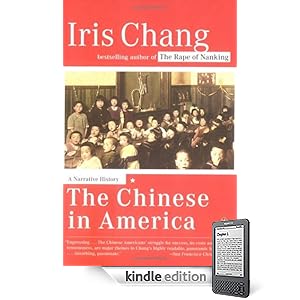
If you are at all interested in Chinese American history, I strongly recommend Iris Chang's The Chinese in America. It takes you on a journey from the first Chinese immigrants working on the transcontinental railroad in California all the way up to the wave of Chinese intellectuals arriving in the 80s and 90s. I warn you: the narrative is extremely depressing and heart-wrenching as the author tries to sway the emotions of the reader. The book made me feel anger, disgust, and humiliation at the horrific way the Chinese were treated. It's definitely a part of American history that I never learned in school textbooks.


Did you know there was a period of time in which Chinese Americans were not allowed to testify against white Americans in court? When Chinese children could not attend the same schools as others? Did you know that opposite Ellis Island was an immigration station on the west coast called Angel Island, basically an interrogation and detention center for Chinese immigrants? Or that during the Cold War, prominent Chinese scientists were ousted after years of hard work for the U.S. government?

I feel lucky that my parents immigrated to the U.S. during the 1990s instead of the 1890s. Not to say there still isn't racism, but at least it is illegal! I personally do not recall ever encountering hatred or intentional discrimination. I grew up in fairly diverse college towns when my parents went to their respective graduate schools. I guess I never really felt that different from my friends, who were of all ethnicities (white, black, Asian, Hispanic).

I have encountered some ignorant but well-meaning remarks. For example, once I was in a Target store with my younger sister and a nice old white lady came up to us, smiled, bowed, and said "Konnichiwa!" (Means Hello in Japanese). When I worked at a grocery store, there were many elderly men and women who would smile at me benevolently and ask me, "Where are you from?" I never knew how to answer the question though I could guess at their intent. Technically I lived just in the next neighborhood, but before that I lived in Wisconsin, and before that, Indiana. Going even further back, I lived in Texas for two years. Before that, I lived in China.

Still, it seems like there is less ignorance and racism with each successive generation. The U.S. is turning ever more into a multicultural melting pot. Technically, we learned in school that our situation isn't really a melting pot, because immigrants keep parts of their own culture and traditions instead of everyone blending together. Therefore, it's more accurate to say that we are a chunky beef stew, with distinct chunks of different foods.

Well, I think that's enough rambling for now. I have much more to write about so I hope to "see" you soon. Question: what are your own experiences with race and culture?